
Carbon Neutrality
Core Principles
Climate change due to global warming is a global environmental challenge that has significant impacts on biological and water resources and causes serious effects on both social infrastructure and business activities, including the increasing frequency of natural disasters. The Otsuka group recognizes these changes as a major business risk to supply chain stability and continuity and considers climate change-related initiatives to be a key management issue.
The group aims to contribute to a sustainable society by reducing greenhouse gas (GHG) emissions in line with the international targets and indicators adopted under the Paris Agreement and by promoting decarbonization of the entire supply chain.
Indicators and Goals
2028
targets
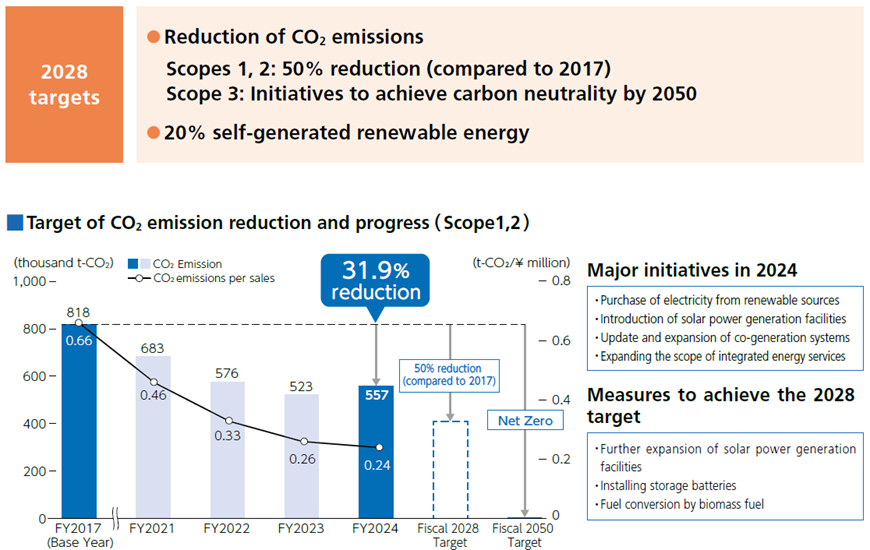
- Reduction of CO2 emissions
Scope 1, 2: 50% reduction (compared to 2017)
Scope 3: initiatives to achieve carbon neutrality by 2050 - 20% self-generated renewable energy
CO2 emissions reduction targets and progress (Scope 1 and 2)
> Please refer to the Integrated Report P87 Carbon neutrality
Commitment Letter to Obtain Science-Based Targets Validation for the Entire Otsuka Group Was Submitted
In January 2026, Otsuka group submitted a letter of commitment*1 to SBTi*2, the certification body for Science-Based Targets (SBT), which are greenhouse gas emission reduction targets based on the Paris Agreement, and announced its intention to aim for SBT certification.
SBT targets have been set at some group companies such as Otsuka Pharmaceutical and Taiho Pharmaceutical, but by setting targets for the Otsuka group, we will accelerate efforts across the entire group.
- *1A corporate climate initiative which was initially founded as a collaboration between CDP, United Nations Global Compact (UNGC), We Mean Business Coalition, World Resources Institute (WRI), and World Wide Fund for Nature (WWF). It validates whether corporate GHG emission reduction targets are consistent with scientific knowledge to achieve the Paris Agreement’s goal of holding the increase in the global average temperature to well below 2°C above pre-industrial levels and pursue efforts to limit the temperature increase to 1.5°C above pre-industrial levels
- *2A Commitment Letter signifies a company’s pledge to set targets aligned with SBT standards and apply to SBTi within two years
Assessment of Reducing the Environmental Impact by Supplying Renewable Energy to Our Business Partners
In April 2024, the Otsuka group began supplying renewable energy to our business partners, to whom we outsource the production of some of the containers for our group’s products. We have evaluated the carbon footprint of our relevant products to quantify the reduction in environmental impact caused by this initiative.
The carbon footprint is a method of converting the greenhouse gas emissions produced throughout the entire lifecycle of our products and services, from raw materials procurement to disposal and recycling, to equivalent CO2 emissions, and evaluating them quantitatively. The Otsuka group is working to reduce CO2 emissions throughout the supply chain by periodically evaluating the environmental impact of its products and using the results to take improvement measures.
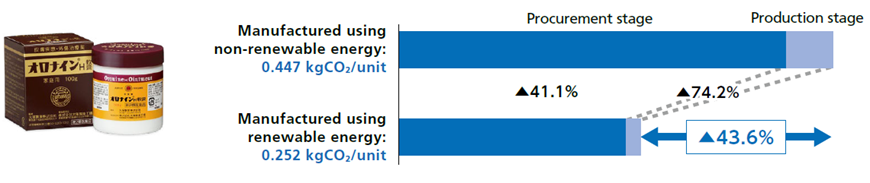
Oronine H Ointment 100g Bottle (excludes product contents)
Oronine-H Ointment is a product for treating minor skin conditions and injuries. The carbon footprint value of this product from the procurement stage to the production stage has been reduced by 43.6%. (At the procurement stage, that includes the carbon footprint values for the containers (bottles) manufactured by a business partner that has adopted renewable energy, as well as the packaging materials (labels, lids, boxes, etc.) manufactured by other suppliers. At the production stage, carbon footprint values from the introduction of renewable energy are included.)
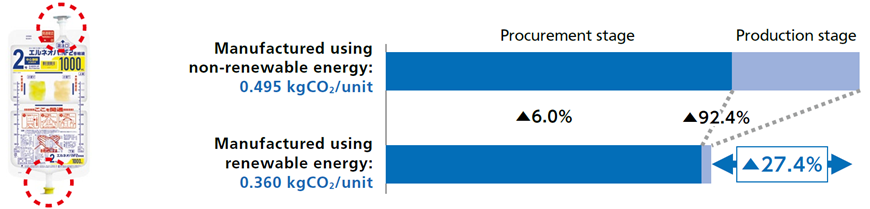
ELNEOPA-NF No.2 Injection 1000mL Soft Bag (excludes product contents)
ELNEOPA-NF No.2 Injection is a kit formulation for high-calorie infusion. The carbon footprint value of this product has been reduced by 27.4%. (At the procurement stage, that includes the carbon footprint values for some of the containers (MP port: circled red) manufactured by a business partner that has adopted renewable energy as well as the packaging materials (such as container films) manufactured by other suppliers. At the production stage, carbon footprint values from the introduction of renewable energy are included.)
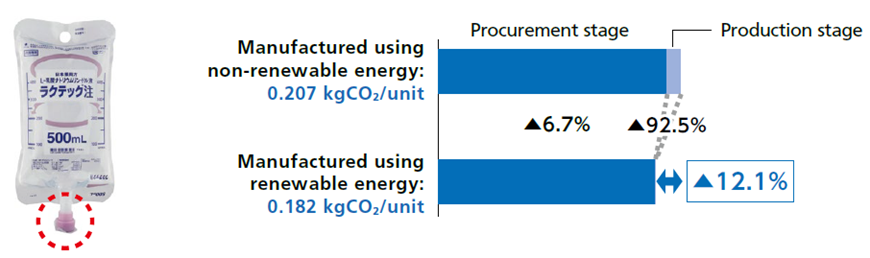
Lactec Injection 500mL Soft Bag (excludes product contents)
Lactec Injection is a lactated Ringer’s solution mainly used as an infusion. The carbon footprint value of this product has been reduced by 12.1%. (At the procurement stage, that includes the carbon footprint values for some of the containers (NC port: circled red) manufactured by a business partner that has adopted renewable energy as well as the packaging materials (such as container films) manufactured by other suppliers. At the production stage, carbon footprint values from the introduction of renewable energy are included.)
Substantial Reduction of CO2 Emissions by Adopting a New Cooking Method in the Bon Curry Brand*1
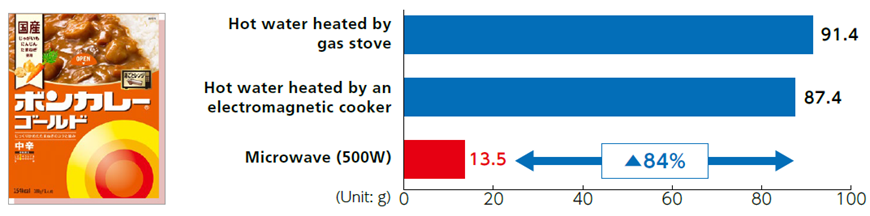
For the Bon Curry brand, Otsuka Foods was one of the first to introduce a microwave-safe pouch that can be microwaved with the entire box after opening the top, instead of the conventional method of cooking with hot water. This improved convenience and reduced CO2 emissions during cooking by approximately 84%*2.
- *1Carbon footprint calculation based on the new cooking method
- *2When heated for 2 minutes at 500W
Comparison of CO2 emissions in the Bon Curry brand