

Business Risks
The Otsuka group’s business operations are subject to various risks. Although the group makes every feasible effort to consider and implement preventive measures with regard to mitigating, transferring, avoiding and accepting foreseeable risk factors, it may be very difficult or impossible to ensure that all risk factors have been reduced or eliminated. If a risk event occurs, it could have a significant adverse effect on the group’s operating results and financial condition.
The group’s risk management system, and the items that the group judges to be its significant risks, are described below, but they do not purport to cover all of the risks associated with the group’s business operations. Forward-looking statements contained in these items are based on the information available as of the fiscal year end.
1. Risk Management System
Overview of Risk Management System
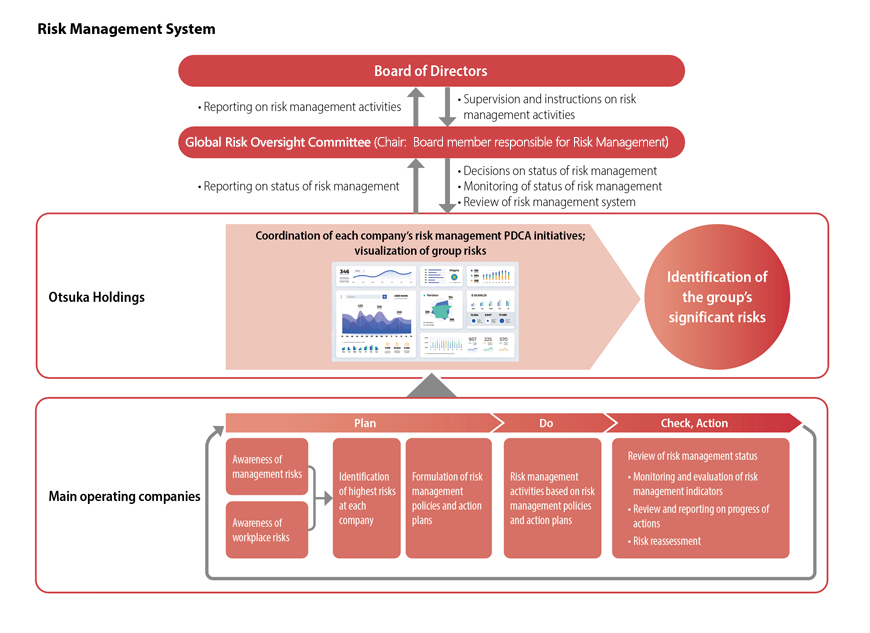
Otsuka group introduced Enterprise Risk Management (ERM) in 2020 to further enhance companywide risk management at Otsuka Holdings (the Company) and its main operating companies, including the recognition and evaluation of risks comprehensively from a company-wide perspective and the prioritization of management resources to control important risks. In 2022, the Otsuka Group Global ERM Policy was established by referencing global standards such as ISO31000 and COSO.
In the initiatives of ERM, we define “risks” as uncertainties that significantly impact the fulfillment of our corporate philosophy and the achievement of our business strategy goals, and we have established a group-wide risk management framework and a system for risk assessment. Under the framework and system, we identify and evaluate significant risks in the group through the risk assessments performed at main operating companies, determine whether to mitigate, transfer, avoid, or accept those risks, formulate management policies, and continuously execute and monitor these activities to effectively and efficiently manage the risks in the group.
The Company has established the Global Risk Oversight Committee, chaired by the Directors & Board Member and composed of t Director & Board Members or senior vice president & operating officers in charge of Finance, Corporate Planning, and Administration. The committee participates in deliberations on significant risks and reports on them at meetings of the Board of Directors, formulates and monitors the implementation of policies for the management of significant risks, and provides instructions and support to the main operating companies when needed. The Board of Directors receives reports on committee activities, issues instructions as necessary, and oversees the effectiveness and efficacy of the group’s ERM structure.
Details of Risk Management Activities
Identification of significant risks begins with the sharing of risk awareness by senior management through interviews at the Company and the main operating companies (top-down approach), as well as assessments of risks and controls by frontline employees (bottom-up approach). This enables us to comprehensively identify the risks that exist in the group. Each group company develops risk management policies and risk management action plans for the risks that are judged to be significant risks and regularly monitors and reviews the status of those risks and the progress of action plans.
The Company aggregates and visualizes the significant risks faced by each group company to grasp a comprehensive understanding of the existing risks and the status of controls in the group. Common risks that apply to the whole group are studied closely and the significant risks are gathered and identified. Based on the results of this process, the Global Risk Oversight Committee assigns priority to significant risks that could a have significant impact on the group’s business, such as financial losses or business continuity.
The Company and the main operating companies develop and implement countermeasures to each significant risk based on the characteristics and risk tolerance. The Company provides the guidance and support to the main operating companies, which submit reports and seek advice from the Company, as appropriate. In these activities, the whole group coordinates closely to promote and practice ERM. Moreover, the Company and the main operating companies regularly monitor risks to prevent their occurrence to the extent possible and ensure that they remain within their respective tolerance levels.
2. Significant Risks
As stated in 1. Risk Management System, based on the results of group-wide risk assessments at the Company and its main operating companies, the Otsuka group recognizes the following significant risks, and is taking necessary actions including mitigation plans for risk management.
(1) Significant Risks in Core Business Areas
① Significant Risks in Pharmaceutical Business
| Healthcare Cost Containment Measure |
|---|
Overview of Risk Governments around the world indicate policies to moderate healthcare costs in order to curb the continuous increase in medical expenses. In Japan, measures such as regular drug price reductions and promotion of generic drug use have been implemented. In the U.S., which is one of the group's important markets, direct price negotiations for brand-name products under the Inflation Reduction Act are being implemented, together with efforts to promote the use of low-priced generic drugs and biosimilars. |
Countermeasures The Otsuka group is working to provide innovative new drugs at appropriate prices, considering factors such as improvement of the healthcare environment, while also demonstrating the value of those new drugs. |
| Uncertainty of New Drug Development |
|---|
Overview of Risk Development of pharmaceuticals and medical devices requires substantial investments in research and development, and the drug development process, including the step of obtaining approval based on strict regulatory review, is a long-term endeavor. Delay or suspension of development due to, for instance, inability to confirm the expected efficacy and safety in clinical trials, could shorten the period of patent exclusivity, allow competing products to reach the market first, or cause us to abandon efforts to market developed products. As a result, the Otsuka group would be unable to obtain revenue commensurate with research and development expenses, which could have an adverse effect on medium-to-long-term business plans. Moreover, a decline in profit margins or recording of impairment losses on assets due to a failure to achieve the expected operating rate of facilities in which the group invested could have a significant adverse effect on the group's operating results and financial condition. |
Countermeasures The Otsuka group has designated to psychiatry and neurology, oncology, cardiovascular and renal, and autoimmune areas as its key therapeutic areas, and is committed to research and development focusing on unmet medical needs which have not been satisfied yet, and is enhancing its pipeline, with the aim of raising the probability of success for development projects in the priority areas. The group enhances monitoring clinical trials, and if problems are recognized, implements countermeasures in cooperation with the relevant departments. |
| Side Effects |
|---|
Overview of Risk The Otsuka group’s pharmaceuticals, medical devices and other products may cause unexpected serious side effects that would affect the safety profile of the product. In that case, the group may be required to respond with measures such as discontinuation of development, discontinuation of sales, revising the package insert or recalling the product, which could have an effect on revenue and development plans for the entire business. |
Countermeasures In addition to the portfolio management described above, the group has established a global safety management system in compliance with the EMA Good Pharmacovigilance Practices (GVP), the ICH E2 series, and WHO guidelines, and conducts the collection and evaluation of safety information worldwide under unified procedures and training. In all countries and regions where the group develops and markets pharmaceuticals, medical devices, related products, safety information collected by group companies or partner companies undergoes medical evaluation, is centrally managed across global databases, and is reported promptly in accordance with the regulations of each country and region based on the ICH E2B (R2/R3) guidelines. Such safety information is subjected to signal detection and medical evaluation in accordance with ICH E2E, and, as necessary, is reflected in revisions to product labeling and risk management plans (RMP), as well as in risk minimization measures. |
| Quality |
|---|
Overview of Risk Quality issues arising from shortcomings in manufacturing processes at suppliers, the group’s own facilities, or contract manufacturers, or from non-compliance with applicable regulations, could result in recalls or suspension of sales. This may disrupt product supply and prevent the provision of appropriate medical treatment to patients. |
Countermeasures The Otsuka group is committed to developing and acquiring technology, nurturing human resources, and persistently pursuing the pinnacle of quality in order to stably supply safe and reliable products to all people. The group keeps cultivating Quality Culture under the "Otsuka Group Quality Policy", aligned with regulations in each country and region, and strengthens the quality system based on the "ICH Q10 Pharmaceutical Quality System Guidelines". Each operating company is constantly working to enhance its quality assurance system by conducting quality control tests for each manufacturing process and ensuring the reliability of data under a quality policy for each characteristic, and thoroughly implementing traceability. In addition, the group has established clearly defined standards for quality control and certification for the business partners including manufacturing and raw material suppliers, and conduct regular confirmations and evaluations of manufacturing management and quality assurance systems based on strict audit standards to ensure product quality as well. |
② Significant Risks in Nutraceutical Business
| Expansion into New Categories and New Regions |
|---|
Overview of Risk In Nutraceutical Business, the Otsuka group is working on contributing to social issues from a global perspective, creating and promoting growth drivers for the next generation, and maintaining a high-profit margin system, under the theme of “becoming a global company with resilience providing health solutions aligned with each life stage”. However, there is the risk that products developed to capture customers' unmet needs may be unsuited to the market, as well as risks in new regions relating to legal regulations, economic conditions, political instability, and uncertainty in the business environment. If such risks were to materialize, they could have a significant adverse effect on the company’s performance and business plans. |
Countermeasures In sustaining and enhancing brand value in its various markets, the Otsuka group has kept an eye on changes in the market environments from the perspectives of both macro and micro levels. Based on the unique characteristics of each product and region, the group tries to mitigate risks from the long term viewpoints of optimizing our strategy as needed. |
| Food Safety and Quality (also applies to Consumer Products Business) |
|---|
Overview of Risk In domestic and international markets, the food industry has faced problems in recent years, such as contamination with harmful substances. The occurrence of an incident that exceeds the group’s quality control capacity could have a significant adverse effect on the Otsuka group’s operating results, financial condition and social trust. |
Countermeasures The Otsuka group is committed to developing and acquiring technology, nurturing human resources, and pursuing the pinnacle of quality in order to stably supply safe and reliable products to all people. The group keeps cultivating Quality Culture under the "Otsuka Group Quality Policy" which is aligned with regulations in each country and region, and working to acquire ISO 9001 (for quality) ,ISO 22000 and FSSC 22000 (for food safety) certifications. Each operating company is consistently committed to implementing production management and quality control, ensuring the reliability of data, thoroughly enforcing traceability, and strengthening the quality assurance system to achieve continuous quality improvement based on its respective policies. |
(2) Significant Risks Common to All Business Areas
| Group Governance and Strategy |
|---|
Overview of Risk Failure to fully realize the benefits from governance under the holding company structure, such as appropriate allocation of resources, planning and review of group strategies, monitoring and supervision of group companies, and group company administration via the main operating companies in business execution in and outside Japan, could have a significant adverse effect on the Otsuka group's operating results and financial condition. Moreover, inability to procure funding as planned or a rise in funding costs due to changes in global economic conditions could have a significant adverse effect on the group's operating results and financial condition. |
Countermeasures In the Otsuka group, strategic decisions and allocation of resources appropriate for the group as a whole are made based on reports of business operations from group companies and analysis of those reports. The group's core businesses are the Pharmaceutical Business and the Nutraceutical Business. In the Pharmaceutical Business, the group concentrates on priority areas such as psychiatry and neurology, oncology, cardiovascular and renal, and autoimmune areas, focusing on unmet medical needs that have not yet been satisfied. In the Nutraceutical Business, the group prioritizes the allocation of management resources, mainly operating functional drinks, foods, and supplements that support the maintenance and enhancement of daily health. Furthermore, to adaptively interpret changes in domestic and international market environments and respond appropriately, the group examines the possible existence of various risks, and promptly reports the findings to management. Specifically, the group focuses on proposing solutions based on new concepts that address substantial needs and social issues, and creating original products and services based on its unique and diverse businesses. In addition, the group's distinctive and diverse products enable it to disperse its overall business risk and respond to changes in the market environment related to changes in personal consumption trends. The group also enacted the “Otsuka Group Global Code of Business Ethics” and related global policies and is using these as the basis of standardized training throughout global operations, which in turn will lead to the creation of a system for the collective control of group companies. Based on matters prescribed in the Regulations of the Board of Directors and the Affiliated Company Management Regulations, information from domestic and overseas group companies is collected and exchanged regularly, and by requiring the approval of the Company for important matters, a group cooperation framework has been established. In addition, the Company periodically conducts internal audits of domestic and overseas group companies and has built a monitoring framework and established a group-wide internal reporting system. The group maintains good relationships with financial institutions and is proactively diversifying its funding sources, and raises funds through bond issues and other methods as necessary. At the same time, in preparation for situations in which market instability and disruption make it difficult to secure sufficient funding through these means, the group is pursuing new funding methods while also consolidating funds within the group through cash pooling and intercompany financing. Based on the latest funding plans, the group has established a structure that enables it to secure funds with an adequate margin. |
| Talent Acquisition and Development, and Embedding of Corporate Culture and Philosophy |
|---|
|
If the corporate culture and corporate philosophy are not sufficiently understood, and if the Otsuka group is unable to secure human capital that can operate its businesses in accordance with the group's strategies, competitiveness and operating results could be adversely affected in the long term. Furthermore, if the group is unable to secure sufficient human capital to carry out critical and high-level strategies such as overseas expansion, M&As and alliances, as well as digital transformation (DX), the group's competitiveness and profitability may not grow as expected, while incidents of misconduct may occur and appropriate responses may not be implemented, which could have a significant adverse effect on the group's operating results and financial condition. |
Countermeasures Under the leadership of executive management, the group has developed and implemented structured programs designed to systematically cultivate the competencies, leadership qualities, and business skills required of management personnel for Otsuka group employees in Japan and overseas. Through these initiatives, the group is continuously developing talent with capability to lead business operations aligned with its group and global strategies. At the same time, each operating company implements its own executive development programs to foster next-generation leaders in accordance with its respective business characteristics. |
| Human Rights |
|---|
Overview of Risk In the global trend of respecting human rights, laws mandating responses to human rights risks are spreading across various countries. Human rights risks refer to the risk of human rights abuses for all individuals involved in business activities. If left unaddressed, these risks can lead to reputational risks, such as loss of trust from customers and society, operational risks such as business stagnation, termination of transactions with business partners, and disruption of supply chains, legal risks including lawsuits and administrative penalties, and financial risks such as divestments and decline in stock prices. These risks would significantly adversely affect the Otsuka group's performance and sustainability. |
Countermeasures Under the "Otsuka Group Global Code of Business Ethics", the Otsuka group complies with the United Nations "Guiding Principles on Business and Human Rights" and has established the "Otsuka Group Human Rights Policy" in 2020. The group has identified important human rights issues for each stakeholder as "Salient Human Rights Issues for Otsuka Group" and under the leadership of the Otsuka Group Human Rights Promotion Officer (Director of Otsuka Holdings), the Otsuka Group Human Rights Task Force promotes initiatives. In addition, major operating companies have established dedicated team structures to address human rights issues and are advancing initiatives tailored to the specific characteristics of their respective businesses. Across the entire group, we are committed to respecting human rights and are building a human rights framework in collaboration with independent external experts, with the aim of generating a positive impact on society. |
| Climate Change |
|---|
Overview of Risk Regarding climate change due to global warming, the increasing frequency and severity of extreme weather events—such as severe heat, droughts, and floods—may lead to reduced yields and deterioration in the quality of agricultural products used as raw materials, potentially resulting in higher procurement costs. In addition, if the transition to decarbonization does not progress appropriately, business operating costs may increase due to factors such as the introduction or strengthening of carbon taxes and rising energy prices. This could also undermine international competitiveness and may have a significant impact on the group’s business performance and sustainable growth. |
Countermeasures Under the Otsuka Holdings Environmental Committee, the Otsuka group has established environmental policies and goals, including the "Otsuka Group’s Environmental Policy" and "Activity Guidelines," and is promoting initiatives based on these frameworks. In particular, with regard to potential financial risks such as rising procurement costs associated with climate change and increasing energy prices resulting from the introduction or strengthening of carbon taxes, the group identifies and assesses climate-related risks and opportunities in accordance with international disclosure requirements and regulations, including those under the ISSB, to which the TCFD framework has been transferred. In addition, the group assesses the financial impacts and the resilience of its business strategies through scenario analysis, and work to mitigate risks and enhance medium- to long-term corporate value by promoting energy conservation, the use of renewable energy, and reductions in greenhouse gas emissions. |
| Supply Chain Transparency |
|---|
Overview of Risk In the supply chain, encompassing the Otsuka group's own operations as well as contract manufacturers, suppliers of raw materials, logistics companies, and sales companies, the occurrence of inappropriate conduct related to human rights, labor, the environment, anti-corruption, or sustainability in general could force a review of the group's business execution framework, harm the group's brand value or credibility, and have a significant adverse effect on the group's operating results and financial condition. |
Countermeasures The “Otsuka Group Global Code of Business Ethics” requires all people involved in the Otsuka group’s business activities to act with high ethical standards. In procurement activities, the group has established the “Otsuka Group Procurement Policy,” which sets forth principles for fair, objective, and transparent supplier selection, as well as compliance with relevant laws and regulations. In addition, with the aim of ensuring quality, safety, and stable supply, and of building an ethical and sustainable supply chain, the group has formulated the “Otsuka Group Sustainable Procurement Guidelines” and the “Otsuka Group Business Partner Code of Ethics.” Based on these frameworks, it obtains agreements from business partners and conducts confirmation and monitoring of suppliers’ initiatives. |
| Corporate Brand Management |
|---|
Overview of Risk Failure to properly cultivate and manage the Otsuka group's corporate brand may adversely affect the group's image. If critical assessments or inaccurate information regarding the group’s business activities or image are disseminated, these and other factors may lead to a decline in the group’s brand value and reputation, which could have a significant impact on its business performance and financial condition. |
Countermeasures To properly cultivate and manage the group's corporate brand, the Company established rules for use of the corporate brand at each group company, and promotes initiatives for management of the corporate brand and maintenance and improvement of its value. The group's corporate symbol is managed primarily by the CI* Management Committee in accordance with unified group rules. |
* CI: Corporate Identity
| Business Alliances and Acquisitions |
|---|
Overview of Risk Business alliances and acquisitions that support the group’s important growth strategies may fail to deliver the business effects initially anticipated if the business environment or other conditions change after implementation. As a result, the profits expected from such alliances and acquisitions may not be realized. In that event, the termination of the alliances or the recognition of impairment losses on goodwill and intangible assets due to inability to realize the anticipated benefits from the acquisition or alliance, could have a significant adverse effect on the group's operating results and financial condition. |
Countermeasures In order to appropriately execute business alliances and acquisitions and to achieve sustainable growth thereafter, our group conducts due diligence and valuation of the target companies and assets, and makes decisions after comprehensive deliberation by the Board of Directors. In addition, it continuously monitors business operations following the completion of such alliances and acquisitions. It also makes use of external experts as appropriate and strives to develop internal personnel with the capabilities required to execute such transactions. |
| Digitalization |
|---|
Overview of Risk If the group's digitalization policy and support measures are not carried out effectively, delays in DX at the group's operating companies may prevent the group from securing a competitive advantage or expanding its market share. This could have a significant adverse effect on the group's operating results and financial condition. |
Countermeasures By harnessing its collective capabilities, the group is striving to introduce advanced technology with a sense of urgency, primarily in group companies and business divisions. As specific measures, the group is conducting proof-of-concept demonstrations and practical application in a variety of contexts, from the research, production, and sales fields, to smartphone apps for patients. ln addition, measures are being taken to raise the base level of IT knowledge and skills group-wide by holding seminars for employees on the latest technologies, such as AI, machine learning and IoT, to improve their IT literacy, and by sharing successful case studies throughout the group. |
| Natural Disasters and Pandemics |
|---|
Overview of Risk Physical damage caused by a large-scale natural disaster, including earthquakes, tsunamis, typhoons, and floods, or a pandemic, such as infectious diseases, could have a significant adverse effect on the Otsuka group's operating results and financial condition. Adverse effects could include interrupted operation of the group's factories, research laboratories, business sites, or other facilities, loss of human resources, delays in the development of new products due to suspended clinical trials in the Pharmaceutical Business, decline in product sales due to inability to appropriately provide treatments to patients, and decline in sales of products in the Nutraceutical Business and other segments due to reduced consumption. |
Countermeasures The Otsuka group has formulated a business continuity plan (BCP) in order to ensure the maximum possible continuation of business operations and the stable supply of products even in the event of disasters such as large-scale earthquakes. Specifically, in preparation for natural disasters, it has established systems to confirm the safety of employees and their families, secured means of communication among the locations of group companies, and maintained emergency stockpiles for disaster response, in addition to conducting regular drills and training exercises. |
| Raw Material Price Hikes |
|---|
Overview of Risk The prices of key raw materials used in the Otsuka group's products fluctuate due to factors including weather, natural disasters, market prices, economic conditions, fuel costs, and exchange rates. If relevant prices surge due to these factors and the situation does not improve, it could increase the manufacturing costs of the affected products or make raw materials unavailable, which could have a major adverse effect on the group's operating results and financial condition. |
Countermeasures To mitigate risks associated with key raw materials price hikes, the Otsuka group implements various countermeasures as a general principle, including procurement of raw materials from multiple suppliers, gathering information on market conditions for raw materials including upstream raw materials, securing alternative raw materials, maintaining appropriate inventory levels, and improving productivity to reduce costs. In addition, even after implementing such countermeasures, the group may pass on increase in raw material prices to selling prices. |
| Infringement of Intellectual Property Rights |
|---|
Overview of Risk Expected earnings may not eventuate if the intellectual property rights that are held by the Otsuka group or licensed to the group by other companies are infringed by a third party. Also, the group might be required to conduct product recalls, terminate manufacturing or sales, and/or pay substantial amounts of compensation if a product manufactured or sold by the group is determined to have infringed a third party’s intellectual property rights. |
Countermeasures The Otsuka group has systems in place to properly manage intellectual property rights, including patents. Through continuous monitoring, the group remains alert to the risk of infringement of its intellectual property rights by third parties. The group also conducts investigations and gathers information using outside experts, databases and investigative organizations to remain alert to the risk of infringement of the intellectual property rights of third parties. In addition, should an intellectual property dispute arise, the group takes steps to minimize the impact on its businesses in cooperation with the relevant parties inside and outside the group. |
| Litigation |
|---|
Overview of Risk Regarding the Otsuka group’s business operations, there is a possibility that a suit may be brought relating to product liability, labor issues, infringement of intellectual property rights, breach of contract, environmental pollution, or other issues. Any judgment, decision or settlement unfavorable to the group could result in a significant adverse effect on the group’s operating results, financial condition, business strategies and social trust. |
Countermeasures The Otsuka group has established an internal reporting system to monitor signs of possible litigation. The Company’s Legal Affairs Department also exchanges information with group companies for responding and supporting appropriately. Furthermore, the Company consults with outside counsel as necessary to reduce litigation risk. |
| Cybersecurity |
|---|
Overview of Risk Within the group, system outages or incidents may arise from various factors, including cyberattacks from external sources, as well as errors or other actions by employees, contractors, or other third parties. Such events could disrupt business operations due to system downtime and may result in the alteration, misuse, or leakage of information. If any of these incidents were to occur, they could have a material adverse effect on the group’s operating results, financial condition, and reputation. |
Countermeasures Across the Otsuka group, it has established the Otsuka Group Global Information Security Policy, which defines our fundamental approach to information security and promotes a shared understanding of the importance of information security management across all group companies. In line with this policy, we provide ongoing education and training for directors and employees to ensure broad awareness of information security throughout the organization. |
| Global Business Operations |
|---|
Overview of Risk Outside of Japan, the Otsuka group conducts business operations mainly in the U.S., Europe and Asia, including research and development, manufacturing and sales activities. In the course of these global business activities, the occurrence of risks including changes or tightening of legal regulations in each country, changes in economic conditions, political instability, and uncertainty in the business environment, could lead to stagnation in business activities or delays or cancellation of business expansion. This could have a significant adverse effect on the group's operating results and financial condition. |
Countermeasures The Otsuka group works to mitigate risks in global expansion by assessing local business environments and business conditions and geopolitical risk impacts, and, as needed, reviewing management strategies from a long-term perspective, while ensuring relevant departments collaborate appropriately in responding to these issues. |
| Geopolitical Risk |
|---|
Overview of Risk The Otsuka group conducts business operations across various regions around the world, and it may be significantly affected by rising geopolitical tensions. In recent years, geopolitical factors have increasingly had a substantial impact on corporate activities, including the strengthening of regulations on critical information and materials between countries and regions, changes to economic security-related legal frameworks and tariff policies in various jurisdictions, and restrictions on logistics resulting from international conflicts. These developments could adversely affect the group’s profitability and supply chain. |
Countermeasures The Otsuka group closely monitors the political, economic, and social conditions in each region, establishing systems to recognize and respond to risks earlier. We regularly analyze and visualize the impact on the group's business activities, review and continuously update our BCP in planning of emergencies, and promote the optimization of the entire supply chain. Additionally, through fair, impartial, and transparent procurement policies and building good relationships with suppliers, the group strives to achieve stable procurement and supply, and stabilize the supply chain. |